
Szczepan Bal is one of the beneficiaries of the competition for funding student and PhD candidates mobility within the HarSval project. He received 10000 PLN funding for the research trip: Workshops SvalGeoBase II, Svalbard.
Enjoy reading his report below:
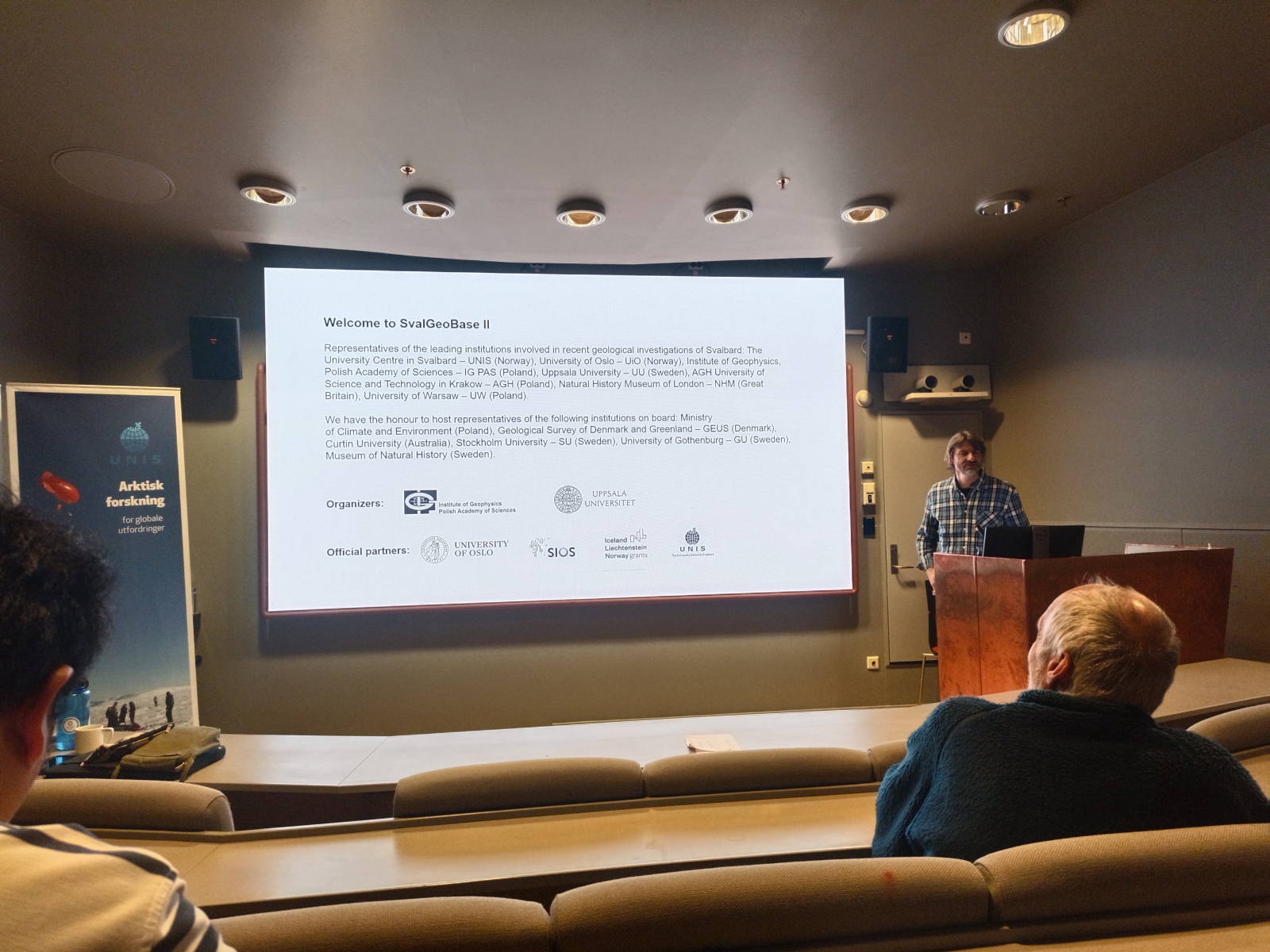
“The SvalGeoBase II workshop, which took place from 03-09.09.2024 on Svalbard, focused on integrating the community of geologists involved in the study of the Arctic and establishing cooperation between them for further scientific research. They allowed to present the work of each participant to a wide range of specialists and receive in return valuable comments and guidance for further activities.
The workshops were held on the training and research ship “Horizon II” of the Maritime University in Gdynia. They included a cruise along the western and northern coasts of Svalbard with presentations of the participants work and field trips. The organizers of these workshops were dr hab. Krzysztof Michalski (Prof. IG PAS) – IG PAS, Prof. Piotr Głowacki – IG PAS and Prof. Jarosław Majka – AGH, Uppsala University, in cooperation with Norwegian partners from the University of Oslo, SIOS (Svalbard Integrated Arctic Earth Observing System), UNIS (The University Centre in Svalbard), HarSval (EEA Grants and Norway Grants). The workshop was attended by prominent geologists from Poland, Australia, Germany, Great Britain, Norway, Sweden, Italy.
My personal goal of going to this workshop, was to establish contacts with the geological “elite” working in the Svalbard area, to present to them the results of my work, to draw from their knowledge and experience. Thanks to the workshop, I expanded my knowledge and improved my skills related to the analysis of the results I received, from the analysis of data in structural geology, through data in mineralogy, petrography, petrology, geochronology, paleomagnetism and issues related to digital terrain models. I was able to plan the next steps in my research procedure. All this knowledge and skills were transferred in a concrete geological context during field trips. I am confident that this experience will certainly be put to good use during my further scientific research. Already, this trip is resulting in a collaboration with the Museum of Natural History in Stockholm, through a short internship in the laboratory, where I can work on my own samples taken on Svalbard.”