
The Harsval project includes also strengthening the mobility of scientists between Polish and Norwegian entities. The outcome will be the integration of the Polish and Norwegian scientific communities, increased cohesion through increased competence and skills, and the creation of new international scientific initiatives based on Polish-Norwegian consortia to solve complex research challenges.
More information about the mobility programme you can found in WP2.
We received a report about the internship to Institute of Earth Sciences, University of Silesia in Katowice from Dr. Joanna Pluto-Kossakowska (Faculty of Geodesy and Cartography, Warsaw University of Technology).
We invite you to enjoy:
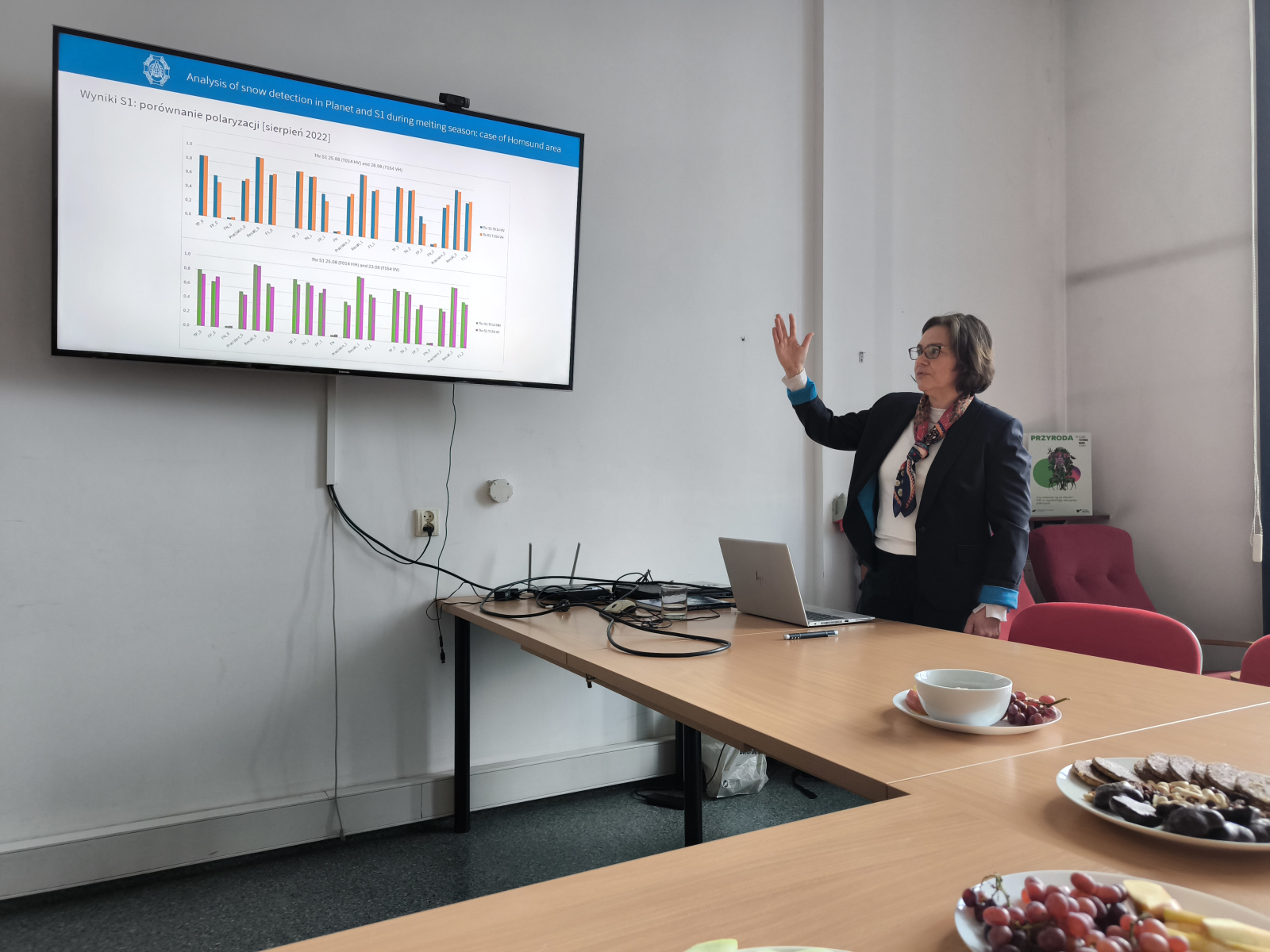
“The purpose of the visit to the Center for Polar Studies (CSP) of the University of Silesia was to establish cooperation and improve skills in methods of processing radar imagery for wet snow detection. Research tasks were carried out to analyze and organize the results of processing remote sensing satellite data in the selected area of Svalbard (Hornsund), obtained earlier (during the internship at the Norwegian Research Institute NORCE). The first task was to determine the degree of correlation between wet snow detection on Sentinel-1 (S-1) radar imagery and DOVE multispectral optical DOVE imagery from the Planet system. The second task was to analyze whether and how radar imaging parameters such as polarization, orbit geometry, reference values and acquisition date affect the accuracy of wet snow range determination. Evaluation of the accuracy of wet snow class determination showed for S-1 slightly better results for data from the descending orbit and HV/HH polarization. The results from both orbits are very close and can be complementary. The conducted studies have shown the usefulness of Planet’s optical imaging for detecting snow during the melting season, as well as other cover classes such as ice, water, exposed rock, vegetation. They are less useful at the beginning of the melting season when the snow cover still persists as dry snow. It is worth highlighting the valuable comments and suggestions I received from the CSP Team during the discussion and seminar. The vast expert knowledge and experience in polar research of Malgosia Blaszczyk and Michal Laska will be reflected in the directions of further research. Many thanks!”